The Translation Layer
The connection every other advisor leaves open.
CLI measures the behavioral leading indicators that decide whether strategy executes — and translates them into the financial results a CFO already reports.
Leading indicators & work behaviors
- Conflict resolution
- Hiring & on-boarding fit
- Post-merger integration
- Culture change
- Sentiment & flight risk
- Succession readiness
Trailing indicators & financial results
- Projected revenue
- Operating-margin trajectory
- Retention & turnover cost
- Merger synergy capture
- 2028 EBITDA / net income
The only platform that translates between them.
Quantified — and tracked over time
Behavioral change isn't a moment. We show it compounding, quarter after quarter.
The platform measures the gap between the culture you have and the one your strategy needs — then projects how closing it plays out across three years, as the change persists. Sentiment is tracked continuously alongside, so you see the signal move before it reaches your results.

OASI synergies tracked quarter by quarter — $15M in Q1 2026 to $255M by Q4 2028 — as the behavioral change persists.
An Investment Banker and Major Consultants tell you the strategy. A CFO tells you if the financials add up. Neither tells you whether your organization is behaviorally capable of executing either.
That gap is what The Future measures — before the decision is made, not after it fails.
Solutions
Built around the decision on your desk.
Not instrument names — the expensive, hard-to-reverse decisions where behavioral evidence changes the outcome.
CEO Succession
See whether your pipeline is behaviorally ready to hold under pressure — before the board vote.
OASI · Board DirectorsM&A Integration
Map where two cultures' reward systems collide, and project the synergy at risk.
OASI · Post-MergerWorkforce Restructuring
Model the behavioral fallout of a reorg against revenue and retention before you announce it.
A-OASI · Scenario ModelingHiring & Role Fit
Rank every candidate against what the role actually demands — with an r² confidence.
ASSET · Fill JobsConflict Resolution
Overlay any two people or teams; the gap between their styles is the conflict — and the path out.
ASI · Peace PadThe Future Platform
Twenty-nine dashboards. Each one gated to the person who needs it.
A live behavioral-intelligence platform — plus an AI Mentor on every screen and a mobile app that feeds the predictive model with anonymous, continuous signal.
CEO Advisory · Board Directors · Investor Relations · Meeting Prep · Post-Merger Updates
Early-Warning KPIs · Scenario Modeling · Behavioral-Outcome (causal) · Investor Behavior
Management Challenges (Peace Pad) · Culture Change · Sentiment · Team Leading Indicators
OASI · Aspirational OASI · Assign CLI Instruments · Employee Leading
Customer Health · External View · Post-Merger Integration
Fill Jobs (ASSET role-fit) · Hiring & On-Boarding · HRIS Import · Data Provenance
The best-fit hire is rarely the best résumé.
Fill Jobs reads what a role actually demands — its behavioral ASSET profile — then scores every candidate's nine Achieving Styles against it and ranks them by fit. You shortlist from evidence, not instinct, before the first interview.
- Each candidate's ASI profile overlaid on the role's ASSET band
- Best / Good / Fair / Weak fit and an r² confidence, computed instantly
- A tighter band marks mission-critical styles — less tolerance for deviation
- Heads off mis-hire cost — typically 1.5–2× annual salary

The role's ASSET band, overlaid with each candidate's ASI profile.

The full candidate pool, ranked by behavioral fit and r² — best-fit highlighted, weak-fit flagged.

Ask your organization a question. Get an answer grounded in behavior.
Trained on management, finance, and the Connective Leadership model — and connected to your measured work-behavior data — the AI Mentor answers the questions executives actually ask.
"Will downsizing affect my startup's culture? And how will that impact performance?"
It sits on every dashboard, alongside Context Help — ready for hypotheticals, board-ready narratives, and sentiment-and-risk reads on demand.
Conflict is a measurable gap — not a personality clash.
The Management Challenge report overlays any two parties' Achieving Styles, quantifies the behavioral gap and friction risk style-by-style, and issues concrete recommendations for every party — and for the organization.
- Behavioral Gap Analysis across all nine styles, with friction risk
- Recommended CLI instruments — ASI, ASI 360°, A-ASI
- Risk & organizational-goals assessment, board-ready

One report: the gap, the friction risk, and recommendations for all parties.

See the impact of a decision before you commit to it.
Bespoke scenario testers for every role. Move the levers — M&A activity, restructure intensity, a hiring freeze, CLI engagement investment — and watch the projected behavioral and financial impact update in real time, per year.
Directional, not predictive. Elasticities are calibrated from CLI's cross-client panel and meant for comparing scenarios against each other — not quoting a number to the cent. For board-grade conviction, pair it with the Behavioral-Outcome What-if Simulator.
A private channel for everyone in the organization.
A separate, encrypted app brings every employee into the loop — without ever exposing them. Identities are never shared with management; responses are aggregated at the department level and repackaged as advice to leaders.
- Anonymous & encrypted — "your opinions are anonymous," with no impact on the individual's job
- Job-hunt inside the organization — roles matched by the employee's ASI against each job's ASSET
- Many avenues of input — wellbeing, engagement, culture, and flight-risk signals
- This continuous, anonymous signal is what feeds the predictive model


Anonymous by design · internal job matching · many avenues of input.
Import once and run standalone — no ongoing dependency. Per-tenant isolation, SSO, and no shared passwords, so your CISO signs off.
The Science
Forty years of validated science. Now operationalized.
The platform runs on the Connective Leadership model — nine Achieving Styles in three sets — the same research CLI once taught only in seminars and lecture halls.
DirectDirectAchieving Styles · SetPeople who prefer the direct set confront their own tasks individually and directly — through intrinsic mastery, competition, and taking charge.
People who prefer the direct set confront their own tasks individually and directly — through intrinsic mastery, competition, and taking charge.
- IntrinsicIntrinsicDirect set
Look within for both motivation and standards of excellence; satisfaction comes from mastering a challenging task autonomously.
- CompetitiveCompetitiveDirect set
Get great satisfaction from performing a task better than anyone else; turn situations into contests to stay motivated.
- PowerPowerDirect set
Like to be in charge of the agenda, task, events, people, and resources; excel at coordinating and organizing.
RelationalRelationalAchieving Styles · SetPeople who prefer to work on group tasks or help others reach their goals — through collaboration, contribution, and vicarious achievement.
People who prefer to work on group tasks or help others reach their goals — through collaboration, contribution, and vicarious achievement.
- CollaborativeCollaborativeRelational set
Enjoy accomplishing a task by doing it with others; energized by teamwork rather than working in isolation.
- ContributoryContributoryRelational set
Like to work behind the scenes to help others accomplish their tasks; satisfaction comes from enabling others' success.
- VicariousVicariousRelational set
Derive a real sense of accomplishment from the success of others, through mentoring and support without direct participation.
InstrumentalInstrumentalAchieving Styles · SetThe instrumental set uses the self and its networks as instruments — personal charisma, social connections, and entrusting others — to accomplish organizational goals.
The instrumental set uses the self and its networks as instruments — personal charisma, social connections, and entrusting others — to accomplish organizational goals.
- EntrustingEntrustingInstrumental set
Know how to make others feel they are counted on; empower people through confident delegation.
- SocialSocialInstrumental set
Accomplish things by involving other people — networking and leveraging knowledge of others' talents and connections.
- PersonalPersonalInstrumental set
Use personality, intelligence, wit, humor, and charm as instruments for success and persuasion.
The foundational text; the model drawn from research on 5,000+ leaders, for leading in an interdependent world.

Leading in an Interdependent World — the foundational text behind CLI's model, drawn from research on 5,000+ leaders. Nominated for a Pulitzer Prize.
The classic organizational-behavior text by CLI co-founder Harold J. Leavitt — the managerial-psychology foundation beneath the Achieving Styles.

Managing Behavior in Organizations — the classic that brought organizational behavior into business-school curricula, by CLI co-founder Harold J. Leavitt.
Briefing Room
One briefing per industry — the behavioral read on who loses the seat, and why, drawn from forty years of data. Pick an industry and open it.
A visual walkthrough of the CLI Dashboards platform — the employee-facing Achieving Styles app, the anonymous CLIRC feedback loop, and the dashboards that run on the same nine-style data. It closes with a real manager-run conflict resolution, start to finish, inside a live enterprise deployment.
Why organizations fail to see what their own people already know — and how the Achieving Styles model turns that blind spot into something a board can measure. A checking function only works when its members achieve differently from those they check.
Watch
The science, in four short films.
Jean Lipman-Blumen and the CLI team on the model that runs beneath the platform.
 YOUTUBE
Specific Style Descriptions
Watch on YouTube → YOUTUBE
The Nine Styles & Subcategories
Watch on YouTube → YOUTUBE
Diversity vs. Interdependence
Watch on YouTube → YOUTUBE
Connective Leadership & the Achieving Styles
Watch on YouTube →In the field
Ninety-second reels
 INSTAGRAM
The Translation Layer
Watch on Instagram → INSTAGRAM
Management Challenges
Watch on Instagram → FACEBOOK
Hiring & Role Fit
Watch on Facebook → LINKEDIN
CEO Advisory
Watch on LinkedIn →On the live site these become in-page players; here each opens the source on YouTube, Instagram, Facebook, or LinkedIn.
Our History
It began in the cellars of the Harvard Computer Center, where SPSS had just been invented and research still ran on punch cards and magnetic tape. From that basement grew six decades of the Achieving Styles™ and Connective Leadership™ models.
About Us
The people behind the science and engineering.
Forty years of research, from the scholars who defined the field to the team bringing it to the enterprise. Hover a name to read more.

Prof. Jean Lipman-Blumen
Co-Founder & President
Hover for bio ▸
Jean Lipman-Blumen recently retired as the Thornton F. Bradshaw Professor of Public Policy and Professor of Organizational Behavior at CGU's Peter F. Drucker and Masatoshi Ito Graduate School of Management. She has served as an assistant director of the National Institute of Education and as special advisor to the Domestic Policy Staff in the White House under President Jimmy Carter.
Professor Lipman-Blumen has consulted to various governments and private-sector organizations and is president of the Connective Leadership Institute, a leadership development, management consulting, and public-policy research firm in Pasadena, CA.
Her areas of expertise are leadership, Achieving Styles, crisis management, "hot groups," organizational behavior, and gender roles. Her current research: connective leadership in a diverse and interdependent world; why followers tolerate toxic leaders; a practical theory of crisis management; and a leadership strategy for global, enduring, and sustainable peace.
She has published seven books, three monographs, and more than 200 articles. Her book The Connective Edge: Leading in an Interdependent World was nominated for a Pulitzer Prize. She has served on several editorial and not-for-profit boards, including the De Pree Leadership Center, the National Women's Museum, and the Ernest Becker Foundation, and is a Board Member Emerita of the International Leadership Association.
She holds an honorary Doctor of Humane Letters from the University of La Verne, spent a year as a Fellow at the Center for Advanced Study in the Behavioral Sciences, and in 2010 received the International Leadership Association's Lifetime Achievement Award.

Prof. Harold J. Leavitt
Co-Founder · 1922–2007
Hover for bio ▸
Harold J. Leavitt was the Walter Kilpatrick Professor of Organizational Behavior at Stanford's Graduate School of Business (1966–1996), and Emeritus Professor until his death in 2007. He is widely regarded as the father of the field of organizational behavior.
His classic textbook Managerial Psychology (1958) brought the discipline into business-school curricula and, in its fifth edition, was translated into 18 languages. His books include Corporate Pathfinders (1986), Hot Groups (1999, co-authored with Jean Lipman-Blumen), and the award-winning Top Down (2005).
He consulted globally and designed executive-education programs at major institutions. Leavitt earned his B.A. from Harvard College, an M.Sc. from Brown University, and a Ph.D. from MIT.

Peter S. Blumen
Chief Executive Officer
Hover for bio ▸
Peter Blumen (Sc.M., MBA) became CLI's CEO in 2024, after serving on its Advisory Board and as an executive — and as a CLI Associate since 1996. Since CLI's inception he has developed its technologies and business opportunities: the original web programming of its behavioral models, migration of the CLI Resource Center to AWS, CLI's first Udemy course, training films, job-hunting applications, and the enterprise "The Future" platform — the most ambitious of these projects.
Previously he was CEO and a major shareholder of several complementary startups. As an investment banker at Cardinal Fund Management and Avalon Securities he advised clients across technology, media, realty, and energy; from 1989–2004 he headed proprietary-trading groups running event-driven, private-placement, quantitative, and distressed strategies. In 2007, as Founding Director of Energy Infrastructure Acquisition Corporation (a $250M public company), he chaired the Audit Committee.
He earned his MBA from Wharton and an Sc.M. in Computer Science and A.B. in Economics from Brown, and held FINRA Series 7, 66 & 79 licenses for 20 years.
Request a demo
The number belongs on your desk — not in an HR report.
If your board is approaching succession, a merger, or a restructuring in the next twelve months, the conversation is thirty minutes long. We'll pre-load it with your public financials.
CLI Academic Access
Research workplace behavior with real Achieving Styles data — free.
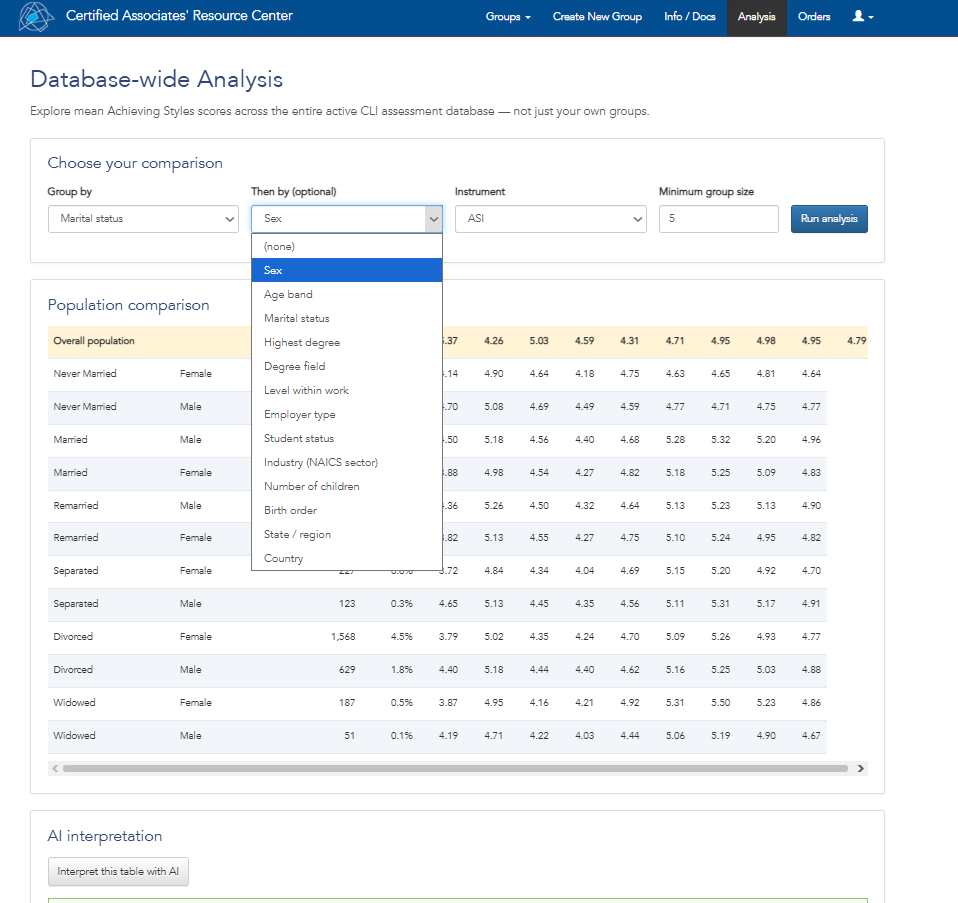
Academics, researchers and students: the CLI assessment database is open to you, free to view and free to analyze. Group more than 44,000 assessed leaders by sex, age, education, industry, role level, country and more, and compare all nine Achieving Styles. Use it to study work behaviors, test your hypotheses and arrive at new insights into workplace behavior and situations. We have already connected an AI agent that interprets whatever analysis you are running. Meet CLI Board members at the ILA Annual Meeting in Toronto to talk through your research.
- Free to view, explore and analyze
- AI interpretation built in for every comparison
- Research-ready charts, tables and CSV downloads